Instructions for LCFGameStick: How to Set It Up?
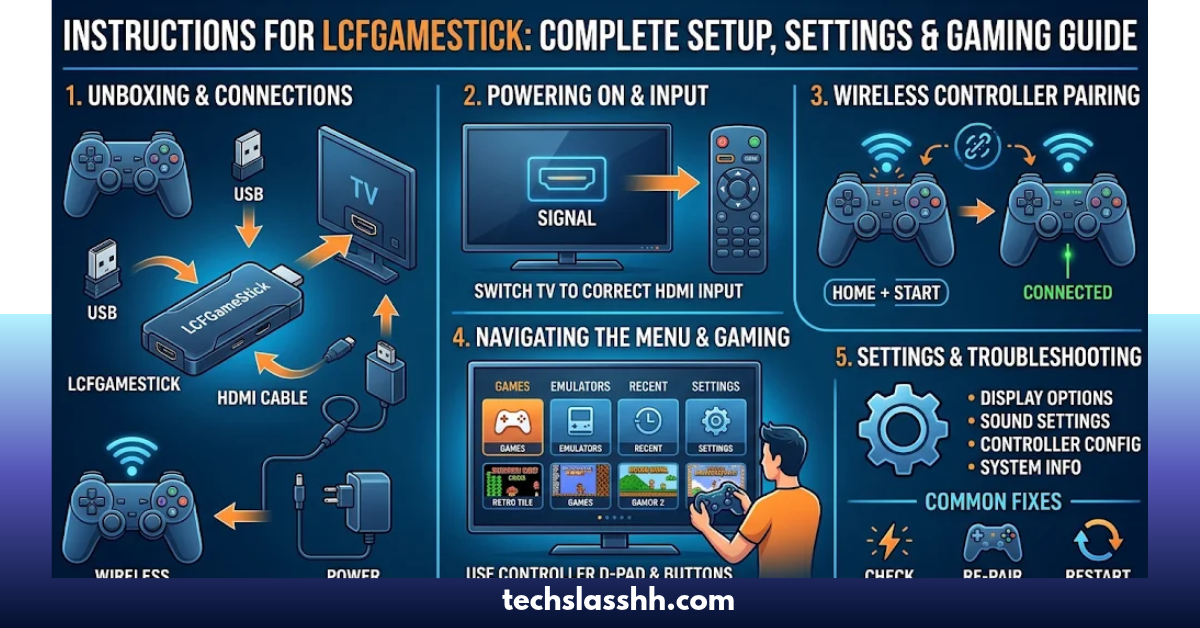
Getting a new gaming device ready should be simple, but confusing cables, unfamiliar controller buttons, and unclear settings can make the first experience frustrating. Without proper instructions for lcfgamestick, users may struggle to connect the device, find the correct HDMI input, or get their wireless controllers working. This guide explains each important step, from initial installation to gaming controls and common troubleshooting solutions, so you can enjoy your gaming experience with confidence.
What Is LCFGameStick?
LCFGameStick is a name associated with HDMI-based gaming devices designed to bring games to a television or compatible display. Its compact design makes it convenient for users who want a gaming setup without installing a large traditional console.
Depending on the hardware version, the package may include a gaming stick, wireless controllers, a USB receiver, an HDMI extension cable, and a power cable.
The device’s exact features, supported games, menu layout, and controller combinations can vary by firmware and hardware revision. Therefore, check your packaging and on-screen system information before following model-specific instructions.
Main features commonly associated with HDMI gaming sticks include:
- Compact hardware that connects through HDMI.
- Wireless controller support on compatible models.
- A menu for browsing available games.
- Retro gaming and classic console emulation.
- Simple television-based gaming.
- Settings for supported display, sound, and controller options.
What Comes in an LCFGameStick Package?
Before installation, identify the accessories supplied with your particular model. Not every seller provides the same equipment.
| Component | Purpose | What to check |
| HDMI Game Stick | Connects the gaming device to your TV | Check the HDMI connector |
| Wireless controllers | Control games and menus | Check battery compartment |
| USB receiver | Connects compatible wireless controllers | Confirm it fits the receiver port |
| HDMI extender | Provides extra space behind the TV | Check both connectors |
| USB power cable | Supplies electricity | Inspect cable condition |
| Power adapter | Supplies suitable USB power | Check the required voltage and current |
| User manual | Provides model-specific instructions | Keep it for reference |
Retro Game Stick Gaming Console 4K HDMI with 2 Wireless Controller 20000+ Games. 634924248592| eBay
If your package contains different accessories, follow the instructions printed on your device or supplied manual instead of assuming that every version uses identical connections.
How to Connect LCFGameStick to a TV
The first important step is connecting the device correctly. A loose HDMI connection or incorrect television input can prevent the gaming menu from appearing.
X2 Ultra 4K HD Retro TV Game Console Ultra Low Latency TV Gamestick 2.4G Wireless Dual Gamepads Controller Home 3D Games | Daraz.com.bd
Follow these steps:
- Locate an available HDMI port on your television.
- Connect the LCFGameStick directly to that port.
- Use the HDMI extension cable if the space behind your TV is limited.
- Connect the USB power cable to the device.
- Connect the power cable to a suitable power source that matches the device’s specifications.
- Turn on your television.
- Select the HDMI input connected to the gaming stick.
- Wait for the startup screen to appear.
Important: Do not assume that every television USB port provides enough power. If the device repeatedly restarts or displays a black screen, check its power requirements and use a compatible adapter.
How to Set Up LCFGameStick for the First Time
After connecting the hardware, complete the initial setup before launching a game.
Buy 20000+ 4K HDMI TV Video Game Stick Retro Gaming Console w/ 2 Wireless Controller Online | Kogan.com
Step 1: Check the Startup Screen
Wait for the device to finish loading. Depending on its firmware, you may see a game library, system menu, or initial configuration screen.
Step 2: Check the Controller Connection
Turn on the supplied wireless controller. If it uses a USB receiver, make sure the receiver is connected properly.
Step 3: Navigate the Main Menu
Use the directional pad to move through available options. The confirmation and back buttons may differ depending on the controller layout.
Step 4: Select a Game
Highlight a game and press the confirmation button. Allow the emulator to load the selected title.
Step 5: Test the Controls
Try moving your character, jumping, selecting an option, and returning to the game menu. This helps identify controller problems before you start playing.
How to Pair LCFGameStick Wireless Controllers
Wireless controllers make television gaming more comfortable because you can play without sitting directly beside the device.
New Wireless Retro Game Console Stick, Built-in 9 Martinique | Ubuy
The pairing method depends on whether your controller uses a USB receiver or Bluetooth.
For a USB receiver controller:
- Switch off the controller.
- Insert its compatible USB receiver into the gaming stick.
- Install the batteries according to the polarity markings.
- Switch on the controller.
- Wait for the indicator light to show its connection status.
- Press the directional buttons to test the connection.
For a Bluetooth controller:
- Open the controller’s pairing mode using its documented button combination.
- Open the device’s Bluetooth settings, if available.
- Select the controller from the available device list.
- Complete pairing.
- Test the controller in the game menu.
Do not use Bluetooth pairing instructions for a controller that only supports a dedicated USB receiver.
LCFGameStick Controller Buttons and Their Functions
Understanding the controller layout makes navigation and gameplay easier. The exact button assignments depend on the game and emulator.
2Pcs 2.4Ghz Wireless Gamepad PC Controller Game Stick GD10 M8 Console Joystick for Android TV | Shopee Philippines
| Controller button | Common function | Where it is used |
| D-Pad Up | Move upward | Menus and games |
| D-Pad Down | Move downward | Menus and games |
| D-Pad Left | Move left | Menus and games |
| D-Pad Right | Move right | Menus and games |
| A | Confirm or action | Menus and games |
| B | Back or secondary action | Menus and games |
| X | Additional action | Supported games |
| Y | Additional action | Supported games |
| Start | Start or pause | Games |
| Select | Secondary menu function | Games and emulators |
| L1/L2 | Left-side actions | Supported games |
| R1/R2 | Right-side actions | Supported games |
| Analog stick | Directional movement | Supported games |
These are common controller conventions, not guaranteed LCFGameStick defaults. Some older games use different button arrangements.
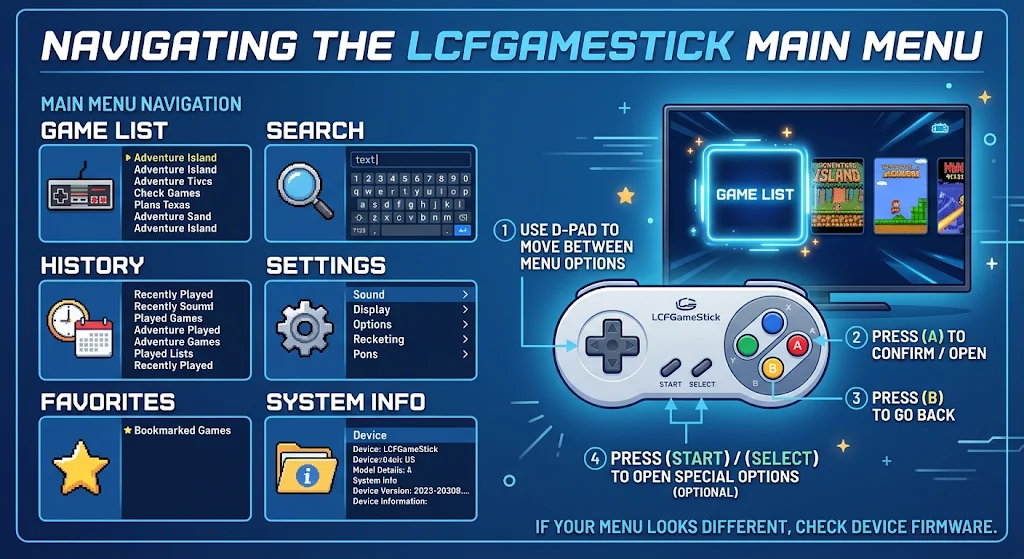
How to Navigate the LCFGameStick Main Menu
The main menu is where users browse their installed game collection and access available system options.
Depending on the firmware, you may find several sections:
- Game List: Displays available games.
- History: Shows recently played titles, if supported.
- Favorites: Stores bookmarked games, if supported.
- Search: Helps locate a particular title, if available.
- Settings: Provides access to system preferences.
- System Information: Displays available device or software information.
Use the directional pad to move between menu options. Press the confirmation button to open a highlighted section and the back button to return.
If your menu looks different, check the device’s firmware version rather than assuming that a missing option indicates a fault.
How to Open LCFGameStick Settings
System settings help users adjust supported features and personalize the gaming experience.
Some Game Stick 4K firmware versions use a dedicated SELECT shortcut on the main game list. Other versions use an on-screen settings icon.
To check your device:
- Return to the main game menu.
- Look for a settings option.
- If your manual identifies SELECT as the settings shortcut, press it once.
- Review the options displayed.
- Select the setting you want to change.
- Confirm your selection.
- Return to the main screen.
Never select a factory-reset option just to explore the menu. Check what it resets first.
Complete LCFGameStick Settings Reference Table
The following table explains common settings found on retro gaming devices. Availability and names can differ across LCFGameStick firmware versions.
| Setting | Purpose | Recommended approach | Important note |
| Language | Changes menu language | Choose a language you understand | Check before confirming |
| Display Resolution | Controls output resolution | Use a TV-supported option | Not every device supports manual adjustment |
| Screen Ratio | Changes image proportions | Try 4:3 for compatible classic games | 16:9 may stretch older games |
| Background Music | Controls menu music | Disable if you prefer silence | May not affect game audio |
| Key Tone | Controls menu button sounds | Set according to preference | Availability varies |
| Controller Settings | Adjusts button assignments | Test before saving | Some emulators have separate controls |
| Audio Settings | Controls supported sound options | Start with default levels | TV audio settings also matter |
| Save State | Saves the current game position | Save before exiting | Depends on emulator support |
| Load State | Restores saved gameplay | Choose the correct save slot | Older saves may be overwritten |
| Restore Defaults | Resets supported preferences | Use only when necessary | May clear personalized settings |
| System Information | Displays device information | Check when troubleshooting | Menu details vary |
Why do these settings matter?
A suitable screen ratio can improve the appearance of older games. Correct controller mapping can also prevent reversed buttons and confusing gameplay.
For emulator-based systems using RetroArch, the official documentation explains that input bindings, hotkeys, and save-state controls can be configured separately.
How to Change the Language on LCFGameStick
A language change can make the entire interface easier to understand.
If your device provides a language setting, follow these steps:
- Return to the main menu.
- Open system settings.
- Locate the language option.
- Select your preferred language.
- Confirm the selection.
- Return to the home screen.
- Check whether the menu labels have changed.
If the screen displays Chinese or another unfamiliar language, use the icons and position of menu options as a guide. However, do not assume that the language option always occupies the first position on every firmware version.
How to Play Games on LCFGameStick
Once your device is connected and the controller responds correctly, you can start exploring the game library.
Gra GAME STICK telewizyjna konsola RETRO HDMI 2 pady ponad 20000 gier – Inny producent | Gry i programy Sklep EMPIK.COM
Follow this simple process:
- Open the main game menu.
- Browse the available game categories.
- Highlight the title you want to play.
- Press the confirmation button.
- Wait for the game to load.
- Test the movement and action buttons.
- Use the documented pause or quick-menu shortcut when needed.
Some devices organize games by platform or category, while others display a single alphabetical list.
If a title does not launch, try another compatible game. One game failing to load does not necessarily mean that the entire device is defective.
How to Save and Load Games on LCFGameStick
Saving progress is particularly important when playing longer games.
Some HDMI gaming sticks support two different saving methods:
In-game save: The game itself saves progress through its own menu or save points.
Save state: The emulator records the current gameplay position so you can return to it later.
Save state images are not viewable from within RetroArch · Issue #13863 · libretro/RetroArch · GitHub
If your device uses RetroArch, the quick menu can provide Save State, Load State, and Close Content options. The controller combination for opening that menu is configurable, so check your installed configuration rather than assuming a universal shortcut.
Libretro Docs+1
Safe saving procedure:
- Pause your game.
- Open the supported quick menu.
- Select Save State if available.
- Choose an appropriate save slot.
- Wait for the save operation to finish.
- Return to the game or close it properly.
When you want to continue, open the same game and select the matching Load State option.
How to Adjust LCFGameStick Screen Resolution and Display
A suitable display setting helps games look better on modern televisions. However, the best resolution depends on the gaming stick’s actual output capabilities.
Retro Video Game with 20,000+ Built-in Games | Classic Console with Ma – Sakuya
Try these steps:
- Open the device’s display settings, if available.
- Check the currently selected resolution.
- Choose a resolution supported by your television.
- Apply the change.
- Check whether the picture displays correctly.
- Return to the previous setting if the screen becomes unstable.
Which Screen Ratio Should You Choose?
| Screen ratio | Best use | Result |
| 4:3 | Many older arcade and console games | Preserves original proportions |
| 16:9 | Modern widescreen displays | Fills most television screens |
| Auto | Compatible automatic display modes | Uses available display detection |
Avoid stretching older games unnecessarily. A stretched image can make characters and objects appear wider than their original design.
How to Configure LCFGameStick Controller Settings
If the controller works but the buttons perform unexpected actions, check the emulator’s input configuration.
For devices running RetroArch, you can generally find controller options under:
Settings → Input
You may be able to adjust:
- Directional controls.
- Button assignments.
- Player 1 and Player 2 controls.
- Analog stick sensitivity.
- Controller profiles.
- Emulator-specific button mapping.
To change controls for an individual game, RetroArch provides a Quick Menu with a Controls section. You can save a remapping for a particular game or emulator core.
Libretro Docs+1
Tip: Change one or two buttons at a time and test them before saving the configuration.
How to Connect LCFGameStick to Different Displays
The device may work with several HDMI-compatible displays, provided the hardware and display support the required connection.
| Display | Connection method | Important requirement |
| Smart TV | HDMI port | Select the correct HDMI input |
| LED TV | HDMI port | Check HDMI compatibility |
| LCD monitor | HDMI port | Check supported resolution |
| Gaming monitor | HDMI port | Check display input compatibility |
| Projector | HDMI input | Check resolution and HDCP compatibility |
Snapklik.com : Wireless Retro Game Console Stick Built-in 20000+ Classic Games, 4K HDMI Output Nostalgia Plug & Play Retro Video Gaming Stick, Retro Game Console
If you use a monitor or projector, make sure it supports the output format of your device.
How to Fix Common LCFGameStick Problems
Even after following the correct instructions for lcfgamestick, users may experience connection, controller, or display problems.
Most basic issues can be investigated without opening the device.
1. LCFGameStick Shows No Signal
Possible reasons:
- Incorrect HDMI input.
- Loose HDMI connection.
- Insufficient power.
- Damaged HDMI cable or port.
Solutions:
- Check the HDMI connection.
- Select the correct HDMI input on your TV.
- Try another HDMI port.
- Check the power cable.
- Restart the television and gaming stick.
2. Wireless Controller Is Not Working
Possible reasons:
- Weak batteries.
- Missing USB receiver.
- Controller switched off.
- Pairing problem.
Solutions:
- Replace the batteries.
- Check the receiver connection.
- Turn the controller off and on.
- Follow the controller’s pairing instructions.
- Test another compatible controller if available.
3. LCFGameStick Keeps Restarting
Repeated restarts can indicate a power or hardware problem.
Try the following:
- Check the USB power cable.
- Use a compatible power adapter.
- Inspect the power connector.
- Disconnect unnecessary USB accessories.
- Restart the device after checking the connections.
If the problem continues, contact the seller or manufacturer for hardware support.
4. Games Are Not Loading
A game may fail to launch because of an incompatible game file, corrupted storage, or an emulator issue.
Try another game from the available library. If multiple games fail, check the device’s storage and software condition.
Do not format the memory card unless you have a verified backup and know how to restore the original system files.
5. LCFGameStick Has No Sound
Check the television volume first.
Then:
- Check whether the TV is muted.
- Inspect the HDMI connection.
- Check the device’s audio settings.
- Try another game.
- Restart the device.
If other HDMI devices produce sound normally but the gaming stick does not, the issue may be related to its audio output or firmware.
6. Controller Buttons Are Reversed
Open the emulator’s input settings, if supported.
Check the A, B, X, and Y assignments. Restore the default mapping if you cannot identify the correct configuration.
7. The Screen Looks Stretched
Check the television’s aspect ratio and the emulator’s video settings.
Select 4:3 when supported for games designed for older television screens. Choose 16:9 when the game and display support widescreen presentation.
Complete LCFGameStick Troubleshooting Table
| Problem | Likely cause | Recommended solution |
| No signal | Wrong HDMI input | Select the correct HDMI source |
| Black screen | Power or display issue | Check power and HDMI connections |
| Controller not responding | Batteries or receiver | Replace batteries and inspect receiver |
| Controller disconnecting | Weak signal or batteries | Move receiver away from interference and test fresh batteries |
| Games not opening | Game or emulator issue | Try another compatible game |
| No audio | TV or device audio settings | Check volume and HDMI connection |
| Stretched picture | Incorrect aspect ratio | Try 4:3 or Auto |
| Device restarting | Power instability | Check adapter specifications |
| Menu language changed | Accidental setting change | Open language settings |
| Save progress missing | Incorrect save slot | Check the original save location |
| Menu freezing | Software or storage issue | Restart safely and check storage |
| Buttons behaving incorrectly | Input mapping | Review controller configuration |
Important Tips for Maintaining Your LCFGameStick
Proper care can help prevent avoidable hardware and software problems.
Follow these practical recommendations:
- Keep the HDMI connector clean and protected.
- Avoid pulling the power cable while the device is running.
- Keep the gaming stick away from excessive heat.
- Use a compatible power adapter.
- Store controllers safely after playing.
- Remove batteries if you will not use the controller for a long period.
- Avoid interrupting save operations.
- Keep the original memory card safe.
- Do not install unknown firmware files.
- Keep your original packaging and purchase information for warranty support.
Memory card protection is particularly important. Removing storage while the device is writing data can damage files or interrupt normal startup.
Is LCFGameStick Suitable for Beginners?
LCFGameStick can be convenient for beginners who want a compact gaming setup and straightforward television connectivity.
Its suitability depends on the actual hardware, game library, controller quality, and software compatibility.
| User type | Potential benefit | What to consider |
| Beginners | Simple HDMI-based setup | Initial controller configuration |
| Children | Accessible game menus | Age-appropriate game selection |
| Retro gaming fans | Access to compatible classic games | Emulator compatibility |
| Families | Shared television gaming | Number of supported controllers |
| Casual players | Compact gaming equipment | Performance limitations |
| Experienced gamers | Configurable controls on supported systems | Hardware and software limitations |
It is important to check the actual specifications before purchasing. Do not assume that a device supports every advertised game, console emulator, or resolution.
LCFGameStick vs. Traditional Gaming Consoles
These devices serve different purposes, so the right choice depends on your expectations.
| Feature | LCFGameStick | Traditional gaming console |
| Physical size | Compact | Generally larger |
| Connection | Usually HDMI | HDMI |
| Setup | Often straightforward | May require updates and account setup |
| Controller | Depends on package | Model-specific controllers |
| Game selection | Depends on installed software | Official supported game library |
| Performance | Hardware-dependent | Varies by console generation |
| Storage | Often removable or built-in | Model-specific storage |
| Online services | Depends on device | Usually more developed |
| Advanced gaming | Limited by hardware | Generally better suited to demanding games |
An HDMI gaming stick may be suitable for casual retro gaming, while a dedicated modern console is usually a better option for demanding contemporary titles.
Frequently Asked Questions
1. How do I set up LCFGameStick for the first time?
Connect the gaming stick to your television’s HDMI port, attach its compatible power supply, connect the controller receiver if supplied, and select the correct HDMI input. Once the main menu appears, test the controller and open a game.
2. How do I connect LCFGameStick to my television?
Insert the device into an available HDMI port. Connect its power cable according to the manufacturer’s specifications, turn on your television, and select the HDMI input used by the gaming stick.
3. Why is my LCFGameStick controller not connecting?
The controller may have weak batteries, an incorrectly connected USB receiver, or a pairing problem. Check the batteries, reconnect the receiver, restart the controller, and follow the pairing procedure for your particular model.
4. How do I open settings on LCFGameStick?
Return to the main game menu and look for the Settings option. Some firmware versions may provide a controller shortcut, such as SELECT. Check your model’s manual because shortcuts can differ.
5. Can I save my game progress on LCFGameStick?
Some versions support in-game saves or emulator save states. If your device runs RetroArch, its Quick Menu may provide Save State and Load State options. The available features depend on the installed software.
6. What should I do if LCFGameStick displays no signal?
Check the HDMI connection, television input, and power supply first. Try another HDMI port and restart the device. If the problem remains, inspect the cables and contact the seller about possible hardware damage.
Conclusion
Following the correct instructions for lcfgamestick makes installation, controller configuration, and everyday gaming much easier. Start by connecting the HDMI device properly, checking its power requirements, pairing the controller, and exploring the available settings.
If you experience problems, use the troubleshooting table to identify the likely cause before changing system configurations or replacing hardware. Always follow the instructions for your exact model because different firmware versions may offer different features.